A reputable China tour operator & China travel agency from 1987

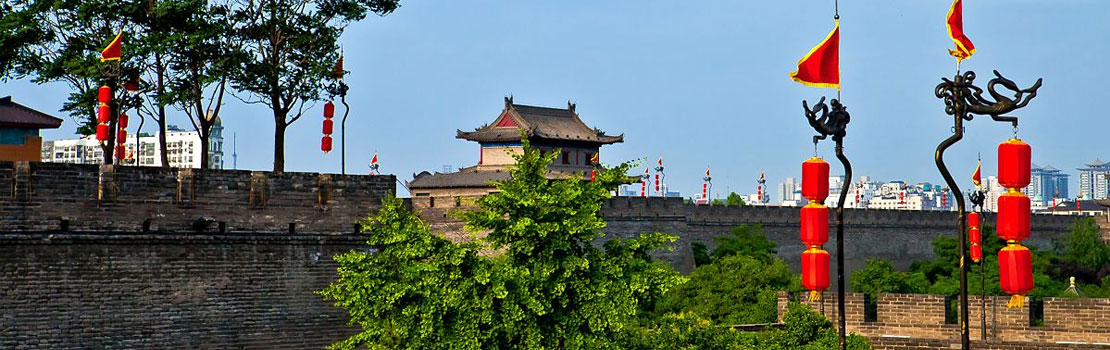
In the Tang Dynasty, the Huaqing Hot Springs was destroyed, during the An Lushan Rebellion. The present-day site is only a small part of the Tang Huaqing Palace. The Huaqing Hot Springs which we see today was rebuilt on the site of the Qing Dynasty structure. The palace covers an area of 85,560 square meters.
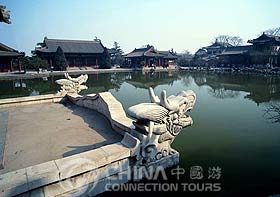 Entering the West Gate of Huaqing Hot Springs, you will see the Nine-Dragon Pool, the Lotus Flower Pool and the Frost Drifting Hall, etc. The Tang Emperor, Xuanzong and his favorite lady, Yang Guifei (Lady Yang), used to make their home in the Frost Drifting Hall. There is always mist and vapor in the air over the pool that is in front of the Hall. In winter, snowflakes fly in the air, and everything in sight becomes white. However, the snowflakes thawed immediately, in front of the Hall. This owes a great deal to the lukewarm vapor that rises out of the hot spring; hence the name of the Frost Drifting Hall.
Close by the Frost Drifting Hall lies the Nine-Dragon Pool. According to legend, the Central Shaanxi Plain was once stricken by a severe drought, in time very long ago. By the order of the Jade Emperor (the Supreme Deity of Heaven), an old dragon came with eight young ones, and made rain here. Yet when the disaster was just abating, the dragons lowered their guard, and the drought became serious again. In a fit of anger, the Jade Emperor kept the young dragons under the Jade Causeway, with the Morning Glow Pavilion and the Sunset Pavilion built on the east and west sides of it to make the young dragons spout clear water all day long to meet the needs of local irrigation. He had the old dragon confined to the bottom of the Roaring Dragon Waterside Pavilion which was situated at the upper end of the Jade Causeway. The old dragon was obliged to control over the young ones.
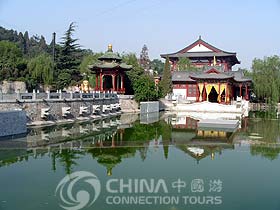 The Nine-Bend Corridor, which lies to the west of the Nine-Dragon Pool leads directly to the Marble Boat. This boat resembles a dragon boat, floating on the water's surface. In the Marble Boat lies the Nine-Dragon Hot Spring Palace where emperor Xuanzong would take his baths. The Nine-Dragon Hot Spring Pool was originally built with crystal jade. Its surface was decorated with carvings of fish, dragons, birds and flowers. In the pool, twin lotus flowers were also carved, and white jade could be seen there as well. The spring water wells up from a break in an earthen jar, and spouts up to lotus flowers, Hence the name, Lotus Flower Pool.
Climb the steps east of the source of hot springs, and you will gradually see the Five-Room Hall where Chiang Kaishek stayed temporarily during the Xi'an Incident.
The peaceful settlement of the Incident put an end to the civil war which had lasted for ten years, and accelerated the formation and development of the United National Front for the Anti-Japanese Drive. Moreover, it showed that the beginnings of cooperative relationships between the Communists and Nationalists arrived at a new level. It marked a great turning point in modern Chinese history.
In the year of 1946 the Nationalist Government had the "National Rejuvenation Pavilion" built near the crevice where Chiang Kaishek had hidden himself during the Incident. It was also called the "Vital Energy Pavilion". Now it has the name of "the Remonstration Pavilion". Close to the pavilion, stands a wooden board, which carries a brief introduction to the Xi'an Incident. Iron chains and rings are fixed up to the crevice, east of the pavilion, by which visitors can climb up, to take a look at Chiang Kaishek's shelter.
Up the winding path, east of the Five-Room Hall, you will see a bridge-like structure. On summer and autumn evenings the sun shines off this bridge in a way that makes it look very much like a rainbow. So it was named the Hovering Rainbow Bridge.