A reputable China tour operator & China travel agency from 1987

 The pagoda is located south of Youyi Road in Xi'an, in what used to be Jianfu Temple in Anrenfang of Tang Dynasty Chang'an, outside the southern gate of Ming Dynasty Chang'an. Along with the Big Wild Goose Pagoda it was an important landmark in Chang'an, capital of the Tang Dynasty. Since it was smaller and built later than the Big Wild Goose Pagoda, it was named the Small Wild Goose Pagoda. It was built in 707 during the Tang Dynasty. As ancient architecture, however, it has kept all its Tang Dynasty features.
The Jianfu Temple, originally located at Kaihuafang of the Tang Dynasty Chang'an, was former residence of Princess Xiangcheng, a daughter of Tang Emperor Taizong. It was originally established in 684 in honor of Li Zhi -- Emperor Gaozong of the Tang Dynasty -- and its original name was the Xianfu Temple, which changed into the Jianfu Temple in 690.
The temple was the place where the great translator Monk Yijing of the Tang Dynasty translated Buddhist scriptures. Yijing set out by sea for India in search of Buddhist principles in 671. After traveling over 30 countries for 25 years, he came back to China with some 400 volumes of holy Sanskrit scriptures, and stayed in the Jianfu Temple. Yijing translated altogether 56 volumes of scriptures in the Jianfu Temple and wrote the book Biography of Eminent Monks of the Tang Dynasty in Search of Buddhist Truth in India, which is of great help to the study of Chinese and Indonesian history and the cultural exchange. Now the only extant ancient architecture in the Jianfu Temple is the Small Wild Goose Pagoda.
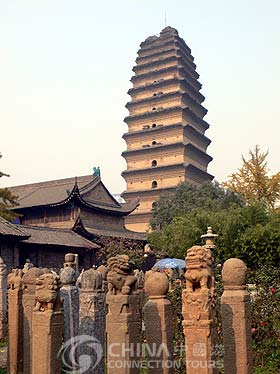 Small Wild Goose Pagoda is a multi-eave, square, brick structure of fifteen storeys. Originally it was 46 meters high, but now it is 43.3 meters high, because its steeple was destroyed. It has a square pedestal and a huge first storey, whose sides measure 11.38 meters long each. Doors on the north and south sides of the first storey have frames built of black stone. Carved on the lintel are images of arhats and designs of grasses, their excellent workmanship reflecting the artistic style of the early Tang Dynasty. The pagoda has fifteen pent roofs. Each storey is very low with small windows only on the south and north sides to let in light and air. They do not correspond to the floors inside. The eaves are formed by designs in the shape of chevrons and fifteen tiers of overlapping bricks, each tier wider than the one below, thus making the eaves curve inward, a characteristic of multi-eave pagodas in the Tang Dynasty. The exterior of the pagoda tapers gradually from the bottom. From the first to the fifth storey it tapers very little, but from the sixth storey up, it reduces drastically, giving the pagoda a smooth curved contour. The tubular interior of the pagoda has wooden flooring and a winding flight of wooden steps leading to other storeys, but there is little space and it is rather dark inside the pagoda. Since people cannot look at the view from the top of the pagoda, it was not built for people to climb up.
The shape and structure of the pagoda are typical of early multi-eave pagodas and influenced many brick and stone runty-eave pagodas built later in other parts of the country.
Small Wild Goose Pagoda, an early attempt at such pagodas, has certain structural weaknesses. Most notable are the small windows on the north and south sides of all storey, reducing the buildings firmness. That defect later caused the pagoda to split vertically into two parts in an earthquake. This weakness was eliminated in other pagodas by avoiding doors and windows on the same sides on all storeys.
According to an inscription made by Wang He on the lintel of the door in the first storey in 1551 in the Ming Dynasty, the pagoda at Jianfu Temple was built in the Tang Dynasty and existed through the Song and Yuan dynasties. In 1487, the last year of the Chenghua period of the Ming Dynasty, an earthquake in Chang'an caused a one-chi [1/3-metre] crack in the pagoda from top to bottom. The fracture was so wide that it looked like windows, and people passing by could see it dearly. In 1521, the last year of the Zhengde period of the same dynasty, another quake occurred and the crack was miraculously closed.
Actually, the crack of five hundred years ago still existed and the roof leaked, causing more damage to the pagoda and putting it in a critical condition. In 1965 the people's government allocated funds to repair the pagoda and consolidate its internal structure. The second, fifth, seventh, ninth and eleventh storey were reinforced with hidden steel girdles; facilities were set up on the roof to protect it from rain and a lightning rod was installed. An office was also set up to take care of the pagoda and other relics