A reputable China tour operator & China travel agency from 1987

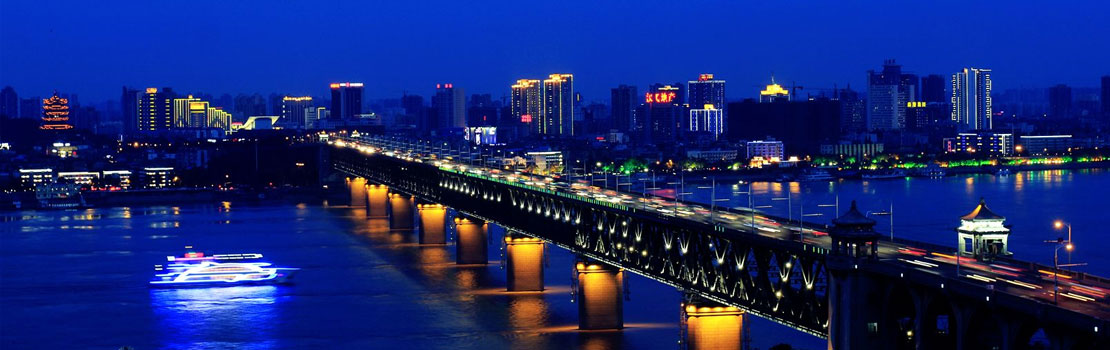
 Wuhan is the provincial capital of Hubei Province and the fifth largest city in China. Located in central China, the city is a major industrial complex and inland port at the confluence of the Han and Yangtze rivers that is accessible to oceangoing vessels. Wuhan was formed in 1950 when three cities-Wuchang, Hankou and Hanyang-were combined into one administrative unit and received a new name, but the cities still retain their individual identities. Hankou, the commercial center and largest of the three, occupies the northwestern quadrant, lying west of the Yangtze and north of the Han River. Hanyang, the smallest of the three and a manufacturing and residential section, lies west of the Yangtze and south of the Han River. Wuchang, the administrative and educational center, is on the eastern bank of the Yangtze. Wuhan is China's traditional base of the manufacturing industry and the origin of China's modern industry.
Geographical Features
Wuhan is situated in the middle of Hubei Province in China, east of Jianghan Plain, and at the intersection of the middle reaches of the Yangtze River and Hanshui River. The Yangtze River and Hanshui River divide Wuhan into three parts: Hankou, Hanyang and Wuchang, which were generally known as Wuhan's Three Towns. Wuhan occupies 8,467 square km, most of which is flat with some hills and abundant lakes and pools. Wuhan has a subtropical monsoon climate with abundant rainfall and four distinct seasons. Wuhan is naturally very charming. There are more than 100 lakes and hills. Because of its hot summer weather, Wuhan is known as one of the "Three Furnaces" of China, along with Nanjing and Chongqing. Wuhan is by far the hottest of the three; the average temperature in July is 37.2 degrees Celsius, and the maximum often exceeds 40 degrees Celsius. The coldest months are January and February with temperatures as low as 5 degrees Celsius. Annual precipitation averages 1,200 millimeters (mainly from February to May). The four seasons in Wuhan are clearly marked with extreme temperatures dominating both summer and winter here. During the hottest months, heat spells can last for weeks on end with little difference between daytime and nighttime temperatures. Although rainfall is fairly high at this time, it provides little respite from the city heat. The best time to visit Wuhan is autumn when temperatures are much more manageable and there is less rainfall than at other times of the year.
Hankou
This area was built on an alluvial plain on the left banks of both the Han and Chang rivers. It is the largest of the three towns and contains Wuhan's port that handles oceangoing vessels. Hankou owes much of its development to the Beijing-Guangzhou Railway, which crosses the Chang at Hankou. The city was opened as a treaty port in 1862, held by the Japanese from 1938 to 1945, and in 1949 passed to the Chinese Communists.
Hanyang
Situated on the right bank of the Han River at its junction with the Chang, Hanyang is the city's industrial center. The city was founded during the Sui dynasty (581-618 AD). It is linked by bridge with Hankou.
Wuchang
Situated on the right bank of the Chang River at the mouth of the Han, Wuchang is an administrative and cultural center with diverse industries. The oldest of the three Wuhan cities, it dates from the Han dynasty (200 BC-200 AD). The first outbreak of the Revolution of 1911, which led to the formation of the Chinese republic, occurred here on October 10. The day is celebrated as the Double Tenth, the tenth day of the tenth month. The city's numerous institutions of higher learning include Wuhan University.
People
Wuhan is the largest city in Central China with a population of 7,565,000. Wuhan natives speak a dialect of Southwestern Mandarin Chinese. The major religion is Buddhism.
History
With a 3,500-year history, Wuhan has been a hotbed of sedition. The first shot of the 1911 Revolution was fired here, and Mao taught Communist theory at the local Central Peasant Movement Institute. In 1927, the National Government announced that Hankou, Wuchang and Hanyang were integrated into the Jingzhao Region and named Wuhan. Wuhan was liberated on May 16, 1949, and was governed directly by the Central Government until June 1954, when it moved under the jurisdiction of the Hubei Provincial Government.
The three cities that make up Wuhan had separate histories until recently. Wuchang was founded in the 1st century AD and was established as a regional capital under the Yuan dynasty (1279-1368). Hankou flourished since the Song dynasty (960-1279) as one of China's leading commercial centers, opening to foreign trade as a treaty port in 1861 and becoming the center of the booming tea trade. The British, Russian, French, German and Japanese all had Foreign Concessions here, and foreign nations enjoyed an imported lifestyle similar to that of foreigners in Shanghai. However, during the 1911 revolution that overthrew the Qing dynasty, Hankou was burnt to the ground. In 1937-38 the Guomindang set up their capital in Hankou, before being pushed out by the Japanese in a bloody battle. At the initiative of a Qing dynasty official, the village of Hanyang became one of the first Chinese-developed factory towns in the 1890s. After suffering from the depression of the 1930s and the Japanese occupation of 1938-45, heavy industry declined and light industry has since prevailed in Hanyang. In 1911, the Republican Revolution broke out in the barracks at Wuchang, which led to the toppling of the last emperor of China. While helping slowly build the Communist movement in China, Mao Zedong ran a Peasant Movement Institute in Wuchang in the late 1920s. The Communist government conglomerated the three separate cities in 1950 and named the resulting city Wuhan. At the start of the Cultural Revolution in 1966, the Chinese press reported that Chairman Mao Zedong (then age 73) swam across the Yangtze River at Wuhan. The story was intended to quash rumors that Mao was either gravely ill or dead.