A reputable China tour operator & China travel agency from 1987

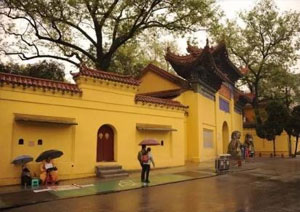 Baotong Temple is now situated almost entirely on the hillside. It is also named Dongshan Temple, or Amitabha Temple, it is located at the southern foot of Hongshan Hill, legendarily built during the period of Song State (420-479), Southern Dynasties. Once popular for its loud bells, and now there exist two large iron bells made in the Southern Song Dynasty (1127-1279), and a pair of stone lions carved in the early years of the Ming Dynasty (1368-1644). At the back hill, there are many pine trees.A Baotong Pagoda is built in memory of a monk master. This is a fairly representative and classic Chinese Buddhist temple, consisting of a Grand Hall, Meditation Hall and the Abbots Hall.
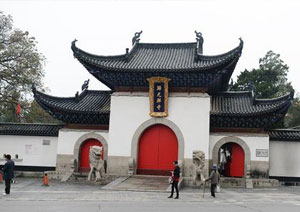 Guiyuan Temple, situated on Cuiwei Street, is one of the four biggest temples for Buddhist meditation in Hubei as well as an important Buddhist temple in China. First built in the early Qing dynasty (1644-1911) by two monks named Baiguang and Zhufeng on the base of Sunflower Garden, the temple got its name from Buddhist chants: "With purity kept in mind, one has the thoroughfare everywhere." Guiyuan Temple has survived through more than 300 hundred years of repeated cycles of prosperity and decline, above all else, it is always leading the other temple in Wuhan with prosperous public worship, flourishing Buddhist ceremony and many pilgrims.
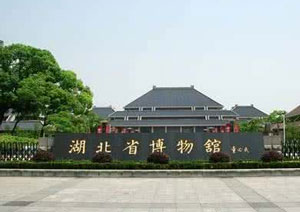 Located on the East Lake, Hubei Museum is one of the best-known museums in China, showcasing numerous State-level historic and cultural relics. Since the establishment of the museum, many exhibitions have been held here. The collections currently hold some 200, 000 objects among which the most astonishing are the objects excavated from the Zenghouyi Tomb. The Zenghouyi Tomb was built about 2400 years ago. The richness of the objects excavated from this tomb and their exquisite beauty has made them one of the rare sights of the world. The musical instruments alone have been called an underground musical palace.
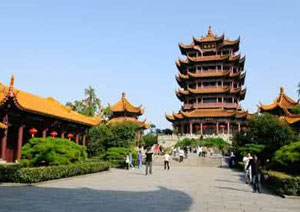 Yellow Crane Tower, located on Snake Hill in Wuchang, is one of the "Three Famous Towers South of Yangtze River (the other two: Yueyang Tower in Hunan and Tengwang Tower in Jiangxi). Legend has it that in Wuchang, there used to be a wine shop opened by a young man named Xin. One day, a Taoist priest, in gratitude for free wine, drew a magic crane on the wall of the shop and instructed it to dance whenever it heard clapping. Thousands of people came to see the spectacle and the wine shop was always full of guests. After 10 years, the Taoist priest revisited the wine shop. He played the flute and then rode on the crane to the sky. In memory of the supernatural encounter and the priest, the Xin's family built a tower and named it Yellow Crane Tower.