A reputable China tour operator & China travel agency from 1987

The late Zhou was a turbulent period. To maintain and increase its power, state rulers sought the advice of teachers and strategists. This fueled intellectual activity and debate, and intense reappraisal of traditions. Thus the period (The Golden Age of Chinese Philosophy) became known as the time when the "hundred schools of thought contended." There were thinkers fascinated by logical puzzles; utopians and hermits who argued for withdrawal from public life; agriculturists who argued that no one should eat who does not plough; military theorists who analyzed ways to deceive the enemy; and cosmologists who developed theories about the forces of nature, including the opposite and complementary forces of yin and yang The three most influential schools of thought that evolved during this period were Confucianism, Daoism, and Legalism.
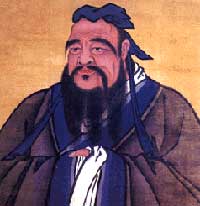 Kongfuzi, or Confucius, as he is known in the West, was a teacher from the state of Lu (in present-day Shandong Province) who lived in the 6th and 5th centuries BC. Confucius revered tradition and encouraged his disciples to study historical records, music, poetry, and ritual. He tried in vain to gain high office, traveling from state to state with his disciples in search of a ruler who would employ him. Confucius talked repeatedly of his vision of a more perfect society in which rulers and subjects, nobles and commoners, parents and children, and men and women would wholeheartedly accept the roles assigned to them, devoting themselves to their responsibilities to others.
Confucius exalted virtues such as filial piety, reverent respect and obedience toward parents and grandparents, humanity, an unselfish concern for the welfare of others, integrity, and a sense of duty. He redefined the term junzi (gentleman) to mean a man of moral cultivation rather than a man of noble birth. He repeatedly urged his students to aspire to be gentlemen who pursue integrity and duty, rather than petty men who pursue personal gain. Confucius's teachings are known through the Lunyu (Analects), a collection of his conversations compiled by his followers after his death. The eventual success of Confucian ideas owes much to Confucius's followers in the two centuries after his death, particularly to Mencius (371-289 BC) and Xunzi (300-235 BC).
Mencius, like Confucius, traveled to various states, offering advice to their rulers. He tried to convince them that the ruler who governed benevolently would earn the respect of the people and would unify the realm. Mencius proposed concrete political and financial measures for easing tax burdens and otherwise improving the people's lives. With his disciples and fellow philosophers, he discussed other issues in moral philosophy, arguing strongly, for instance, that human nature was fundamentally good as everyone is born with the capacity to recognize what is right and act upon it.
Xunzi took the opposite view of human nature, arguing that people are born selfish and that it is only through education and ritual that they learn to put moral principle above their own interests. Xunzi stressed the importance of ritual in social and political life, but took a secular view, arguing that the ruler should pray for rain during a drought because to do so is the traditional ritual, not because it moves Heaven to send rain.
The doctrines of Daoism, the second great school of philosophy that emerged during the Warring States Period, are set forth in the Daodejing, Classic of the Way and Its Power, which is attributed traditionally to Laozi (570-490 BC), and in the compiled writings of Zhuangzi (369-286 BC). Both works share a disapproval of the unnatural and artificial. Whereas plants and animals act spontaneously in ways appropriate to them, humans have separated themselves from the Way (Dao) by plotting and planning, analyzing and organizing. Both texts reject social conventions and call for an ecstatic surrender to the spontaneity of cosmic processes. At the political level, Daoism advocated a return to primitive agricultural communities in which life could follow the most natural course. Government policy should be one of extreme noninterference, permitting the people to respond to nature spontaneously.
The Zhuangzi is much longer than the Daodejing. A literary masterpiece, it is full of tall tales, parables, and fictional encounters between historical figures. Zhuangzi poked fun at people mired in everyday affairs and urged people to see death as part of the natural cosmic processes.
Legalism differed from both Confucianism and Daoism in its narrow focus on statecraft. Thinkers like Han Fei (280-233 BC) reasoned that the extreme disorders of their day called for new and drastic measures. They rejected the Confucian theory that strong government depended on the moral quality of the ruler and his officials and their success in winning over the people. Rather, they argued, it depended on effective systems of rewards and punishments. To ensure his power, the ruler had to keep his officials in line with strict rules and regulations and his people obedient with predictably enforced laws.